
Science
CDAC has three scientific thrusts and four cross-cutting themes that link the center.
I. Thermomechanical Extremes
Goal: To enhance understanding of materials in extreme conditions by advancing the evolving synergy between static, quasi-static, and dynamic compression techniques over a broad range of strain and strain rates in close synergy with theory, modeling, and simulation.
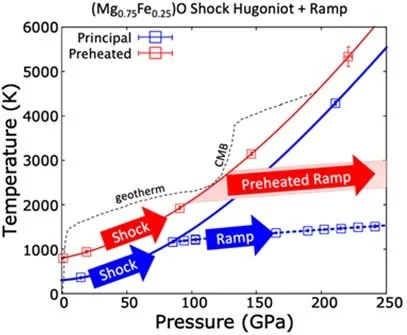
DFT-MD predicted shock-ramp of (Mg0.75Fe0.25)O with low-spin Fe (blue) used in planning the CDAC team’s upcoming Z-shot. To reach a second, higher-T isentrope, a pre-heated “gapless” target is being designed. [Calculations by CDAC student Hannah Bausch (NU) with former CDAC student Joshua Townsend (SNL)].
-
1683. Kraus, R. G., R. J. Hemley, S. J. Ali, J. L. Belof, L. X. Benedict, J. Bernier, D. Braun, R. E. Cohen, G. W. Collins, F. Copari, M. P. Desjarlais, D. Fratanduono, S. Hamel, A. Krygier, A. Lazicki, J. McNaney, M. Millot, P. C. Myint, M. G. Newman, J. R. Rygg, D. M. Sterbentz, S. T. Stewart, L. Stixrude, D. C. Swift, C. Wehrenberg, and J. H. Eggert, Measuring the melting curve of iron at super-Earth core conditions. Science 375, 202-205 (2022).[OSTI ID 1840054]
1685. Perreault, C., L. Q. Huston, K. Burrage, S. C. Couper, L. Miyagi, E. K. Moss, J. S. Pigott, J. S. Smith, N. Velisavljevic, Y. Vohra, and B. T. Sturtevant, Strength of tantalum to 276 GPa determined by two x-ray diffraction techniques using diamond anvil cells. Journal of Applied Physics 131, 015905 (2022). [OSTI ID 1843424]
1693. Dorfman, S. M., S. Najiba, B. Arroyo, S. Theuer, M. Lv and B. L. Brugman, Control of deviatoric stress in the diamond anvil cell through thermal expansion mismatch stress in thin films. Physics and Chemistry of Minerals 49, 16 (2022). [OSTI ID 1867017]
Duwal, S., R. C. Clay III, M. D. Knudson, J. Boerner, K. Cochrane, J. Usher, D. Dolan, B. Farfan, C. de La Cruz, J. Banasek, C. T. Seagle, R. Hacking, S. Payne, C. Zoller, M. Ahart, and R. J. Hemley, Extreme compression of planetary gases: High-accuracy pressure-density measurements of hydrogen-helium mixtures above 4-fold compression. Physical Review Letters, submitted.
Clark, A.N., J.M.D. Lane, J.P. Davis, A.R. Sarafian, K.R. Cochrane, J.P. Townsend and S.D. Jacobsen. Shock-ramp of SiO2 melt. Journal of Physics Condensed Matter, in press.
II. Chemical and Material Extremes
Goal: To advance our understanding of extreme chemical and physical properties, including novel structure and bonding at high densities, extreme chemical reactivity, and exotic physical properties such as very high-temperature superconductivity and novel dielectric and magnetic phenomena.
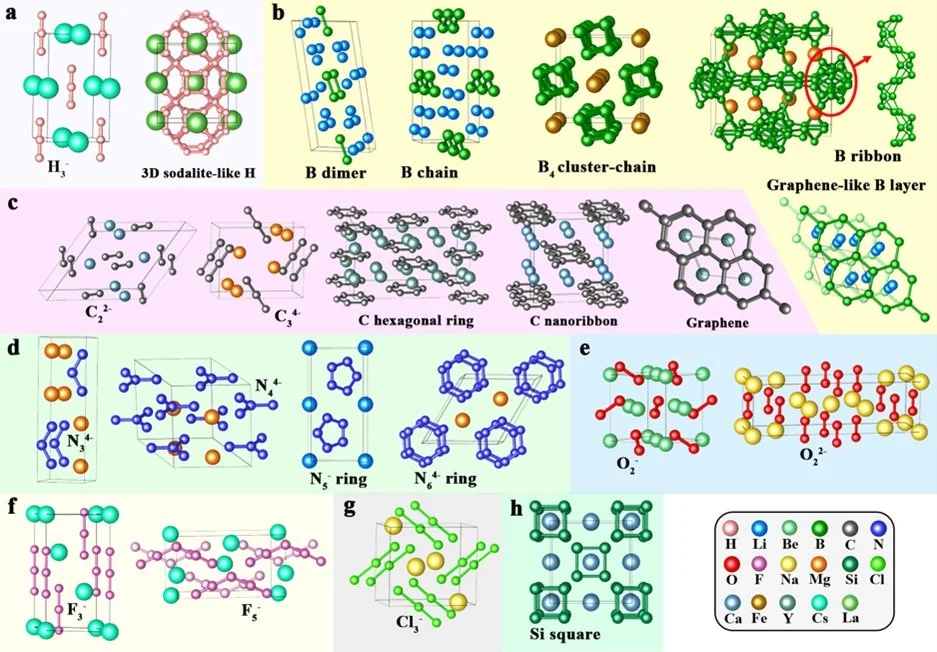
Examples of the novel structures and bonding that emerge at extreme pressures, specifically selected homonuclear species present in atypical high-pressure compounds [Miao et al., Nature Chem. Rev. 4, 508-527 (2020)]
-
1634. Klein, R. A., J. P. S. Walsh, S. M. Clarke, Z. Liu, E. E. Alp, W. Bi, Y. Meng, A. B. Altman, P. Chow, Y. Xiao, M. R. Norman, J. M. Rondinelli, S. D. Jacobsen, D. Puggioni and D. E. Freedman, Pressure-Induced Collapse of Magnetic Order in Jarosite. Physical Review Letters 125, 077202 (2020). OSTI ID 1650655]
1691. Wang, X., T. Bi, K. P. Hilleke, A. Lamichhane, R. J. Hemley and E. Zurek, Dilute carbon in H3S under pressure. NPJ Computational Materials 8, 87 (2022). [OSTI ID 1865713]
1707. Tamerius, A. D., A. B. Altman, M. J. Waters, E. A. Riesel, C. D. Malliakas, M .L. Whitaker, T. Yu, G. Fabbris, Y. Meng, D. Haskel, Y. Wang, S. D. Jacobsen, J. M. Rondinelli, and D. E. Freedman, Synthesis of the candidate topological compound Ni3Pb2. Journal of the American Chemical Society 144, 11943-11948 (2022).
1711. Sun, Y., L. Zhao, C. J. Pickard, R. J. Hemley, Y. Zheng and M. Miao, Chemical interactions that govern the structures of metals. Proceedings of the National Academy of Sciences USA 120, e2218405120 (2023). [OSTI ID 1925232]
1713. Hilleke, K. P. and E. Zurek, Chemistry at High Pressure. In Comprehensive Inorganic Chemistry III; Theory and Bonding of Inorganic Non-Molecular Systems. Frederickson, D. C., J. Reedijk, and K. R. Poeppelmeier, Eds. Elsevier (2023). [OSTI ID 1968603]
III. Multiple Extremes
Goal: To advance our knowledge of the behavior of materials exposed to multiple extreme environments, including intense particle and electromagnetic fields, to enhance material performance and to create new materials.
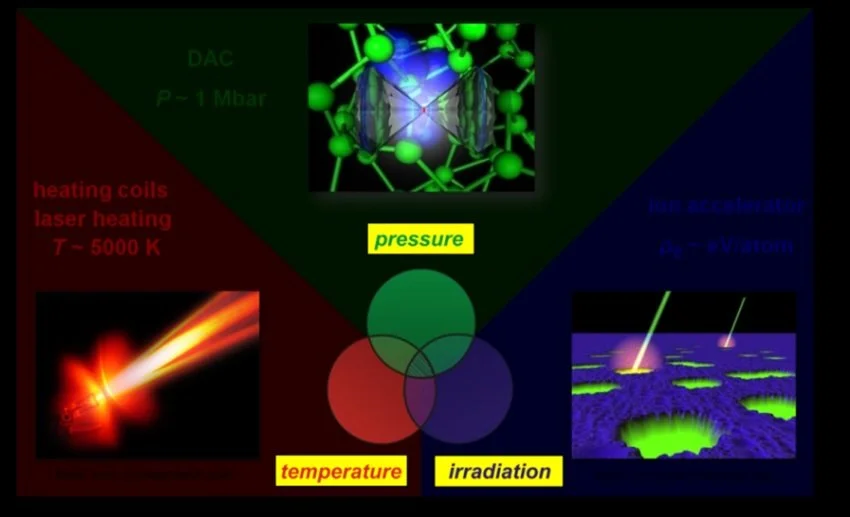
CDAC’s key strategy to investigating the response of materials to the coupled extreme conditions of P, T, and ion irradiation.
-
1668. Cureton, W. F., C. L. Tracy and M. Lang, Review of swift heavy ion irradiation effects in CeO2. Quantum Beam Science 5, 19 (2021). [OSTI ID 1813554]
1687. Grockowiak, A. D., M. Ahart, T. Helm, W. A. Coniglio, R. Kumar, K. Glazyrin, G. Garbarino, Y. Meng, M. Oliff, V. Williams, N. W. Ashcroft, R. J. Hemley, M. Somayazulu, and S. W. Tozer, Hot hydride superconductivity above 550 K. Frontiers in Electronic Materials: Superconductivity 2, 837561 (2022). [OSTI ID 1862863]
1703. Overstreet, C., J. Cooper, E. O’Quinn, W. Cureton, R. Palomares, J. Leys, G. Deissmann, S. Neumeier, C. Chen, and M. Lang, Structural stability of REE-PO4 (REE=Sm,Tb) under swift heavy ion irradiation. Nuclear Instruments and Methods in Physics Research B 527, 34-39 (2022). [OSTI ID 1901277]
Cross-Cutting Themes
Material Properties: Use of multiple techniques to characterize key properties materials in extreme environments.
Targeted Materials: Investigating specific materials of fundamental and applied interest.
Experiment and Theory: Enhancing synergies between experiment, theory, and simulation.
Advanced Radiation Facilities: Extensive use of advanced synchrotron, neutron, laser, Z-pinch, and other facilities at DOE/SC and DOE/NNSA labs.
-
1634. Klein, R. A., J. P. S. Walsh, S. M. Clarke, Z. Liu, E. E. Alp, W. Bi, Y. Meng, A. B. Altman, P. Chow, Y. Xiao, M. R. Norman, J. M. Rondinelli, S. D. Jacobsen, D. Puggioni and D. E. Freedman, Pressure-Induced Collapse of Magnetic Order in Jarosite. Physical Review Letters 125, 077202 (2020). [OSTI ID 1650655]
1685. Perreault, C., L. Q. Huston, K. Burrage, S. C. Couper, L. Miyagi, E. K. Moss, J. S. Pigott, J. S. Smith, N. Velisavljevic, Y. Vohra, and B. T. Sturtevant, Strength of tantalum to 276 GPa determined by two x-ray diffraction techniques using diamond anvil cells. Journal of Applied Physics 131, 015905 (2022). [OSTI ID 1843424]
1693. Dorfman, S. M., S. Najiba, B. Arroyo, S. Theuer, M. Lv and B. L. Brugman, Control of deviatoric stress in the diamond anvil cell through thermal expansion mismatch stress in thin films. Physics and Chemistry of Minerals 49, 16 (2022). [OSTI ID 1867017]
Lim, J., S. Sinha, A. C. Hire, J. S. Kim, P. M. Dee, R. S. Kumar, D. Popov, R. J. Hemley, R. G. Hennig, P. J. Hirschfeld, G. R. Stewart, and J. J. Hamlin, Suppression of superconductivity in Nb-substituted MoB2 at high pressure. Physical Review B, in press.
Deng, L. Z., M. Gooch, H. X. Liu, N. P. Salke, T. Bontke, S. Shao, J. Y. You, D. J. Schulze, R. Kumar, J. X. Yin, R. J. Hemley, Y. P. Feng, G. Shang, Q. M. Si, and C. W. Chu, Effect of Fermi surface topology change on the superconducting state of the Kagomé superconductor CeRu2 under pressure. Proceedings of the National Academy of Sciences USA, submitted.
1691. Wang, X., T. Bi, K. P. Hilleke, A. Lamichhane, R. J. Hemley and E. Zurek, Dilute carbon in H3S under pressure. NPJ Computational Materials8, 87 (2022). [OSTI ID 1865713]
1707.Tamerius, A. D., A. B. Altman, M. J. Waters, E. A. Riesel, C. D. Malliakas, M .L. Whitaker, T. Yu, G. Fabbris, Y. Meng, D. Haskel, Y. Wang, S. D. Jacobsen, J. M. Rondinelli, and D. E. Freedman, Synthesis of the candidate topological compound Ni3Pb2. Journal of the American Chemical Society144, 11943-11948 (2022).
1711. Sun, Y., L. Zhao, C. J. Pickard, R. J. Hemley, Y. Zheng and M. Miao, Chemical interactions that govern the structures of metals. Proceedings of the National Academy of Sciences USA 120, e2218405120 (2023). [OSTI ID 1925232]
1713. Hilleke, K. P. and E. Zurek, Chemistry at High Pressure. In Comprehensive Inorganic Chemistry III; Theory and Bonding of Inorganic Non-Molecular Systems. Frederickson, D. C., J. Reedijk, and K. R. Poeppelmeier, Eds. Elsevier (2023). [OSTI ID 1968603]
-
1657. Geballe, Z. M., M. Somayazulu, N. Armanet, A. K. Mishra, M. Ahart and R. J. Hemley, Synthesis and thermodynamic stability of PdH1±ε up to 8 GPa. Physical Review B 103, 024515 (2021). [OSTI ID 1766801]
1677. Brugman, B. L., F. Lin, M. Lv, C. Kenney-Benson, D. Popov, L. Miyagi and S. M. Dorfman, Strength, deformation and equation of state of tungsten carbide to 66 GPa. Acta Materialia 220, 117301 (2021). [OSTI ID 1830374]
1684. Zhang, Y., K. Luo, M. Hou, P. Driscoll, N. P. Salke, J. Minár, V. B. Prakapenka, E. Greenberg, R. J. Hemley, R. E. Cohen, and J.-F. Lin, Thermal conductivity of Fe-Si alloys and thermal stratification in Earth’s core. Proceedings of the National Academy of Sciences USA 119, e2119001119 (2022). [OSTI ID 1839070]
1699. Huston, L., S. C. Couper, M. Jacobsen, E. K. Moss, L. Miyagi, J. S. Smith, N. Velisavljevic and B. T. Sturtevant, Yield strength of CeO2 measured from static compression in a radial diamond anvil cell. Journal of Applied Physics 132, 115901 (2022). [OSTI ID 1888569]
Duwal, S., R. C. Clay III, M. D. Knudson, J. Boerner, K. Cochrane, J. Usher, D. Dolan, B. Farfan, C. de La Cruz, J. Banasek, C. T. Seagle, R. Hacking, S. Payne, C. Zoller, M. Ahart, and R. J. Hemley, Extreme compression of planetary gases: High-accuracy pressure-density measurements of hydrogen-helium mixtures above 4-fold compression. Physical Review Letters, submitted.
Clark, A.N., J.M.D. Lane, J.P. Davis, A.R. Sarafian, K.R. Cochrane, J.P. Townsend and S.D. Jacobsen. Shock-ramp of SiO2 melt. Journal of Physics Condensed Matter, in press.
-
1671. Sweeney, C. M., B. Sturtevant, C. M. Biwer, C. A. Bolme, R. C. Huber, L. Q. Huston, E. McBride, L. Miyagi, C. Prescher, K. J. Ramos, J. Smith and T. Turton, Data Science and Computation for Rapid and Dynamic Compression Workflows at Experimental Facilities. Workshop Report LA-UR-20-27469, Los Alamos National Laboratory (2021). [LINK]
1682. Altman, A., A. Tamerius, N. Koocher, Y. Meng, C. Pickard, J. P. S. Walsh, J. Rondinelli, S. D. Jacobsen, and D. Freedman, Computationally directed discovery of MoBi2. Journal of the American Chemical Society 143, 214-222 (2021).
1706. Lim, J., A. C. Hire, Y. Quan, J. S. Kim, S. R. Xie, S. Sinha, R. S. Kumar, D. Popov, C. Park, R. J. Hemley, Y. K. Vohra, J. J. Hamlin, R. G. Hennig, P. J. Hirschfeld, and G. R. Stewart, Creating superconductivity in WB2 through pressure-induced metastable planar defects. Nature Communications 13, 7901 (2022). [OSTI ID 1906641]
Wang, B., K. P. Hilleke, S. Hajinazar, G. Frapper, and E. Zurek, Structurally constrained evolutionary algorithm for the discovery and design of metastable phases. arXiv: 2306.01873.
-
1683. Kraus, R. G., R. J. Hemley, S. J. Ali, J. L. Belof, L. X. Benedict, J. Bernier, D. Braun, R. E. Cohen, G. W. Collins, F. Copari, M. P. Desjarlais, D. Fratanduono, S. Hamel, A. Krygier, A. Lazicki, J. McNaney, M. Millot, P. C. Myint, M. G. Newman, J. R. Rygg, D. M. Sterbentz, S. T. Stewart, L. Stixrude, D. C. Swift, C. Wehrenberg, and J. H. Eggert, Measuring the melting curve of iron at super-Earth core conditions. Science 375, 202-205 (2022). [OSTI ID 1840054]
1703. Overstreet, C., J. Cooper, E. O’Quinn, W. Cureton, R. Palomares, J. Leys, G. Deissmann, S. Neumeier, C. Chen, and M. Lang, Structural stability of REE-PO4 (REE=Sm,Tb) under swift heavy ion irradiation. Nuclear Instruments and Methods in Physics Research B 527, 34-39 (2022). [OSTI ID 1901277]
1709. Geng, N., K. P. Hilleke, L. Zhu, X. Wang, T. A. Strobel, and E. Zurek, Conventional high-temperature superconductivity in covalently bonded, binary-guest C-B clathrates. Journal of the American Chemical Society 145, 1696-1706 (2023). [OSTI ID 1908975]
1716. van Veenendaal, M., E. H. T. Poldi, L. S. I. Veiga, P. Bencok, G. Fabbris, R. Tartaglia, J. L. McChesney, J. W. Freeland, R. J. Hemley, H. Zheng, J. F. Mitchell, J.-Q. Yan, and D. Haskel, Electronic structure of Co 3d states in the Kitaev material candidate honeycomb cobaltate Na3Co2SbO6 probed with x-ray dichroism. Physical Review B 107, 214443 (2023). [OSTI ID 1987546]
1719. Musfeldt, J. L., D. G. Mandrus, and Z. Liu, Insulator-metal transition in CrSiTe3 triggered by structural distortion under pressure. NPJ 2D Materials and Applications 7, 28 (2023) (FIS). [OSTI ID 1994209]
Pasan, H., E. Snider, S. Munasinghe, S. E. Dissanayake, N. P. Salke, M. Ahart, N. Khalvashi-Sutter, N. Dasenbrock-Gammon, R. McBride, G. A. Smith, F. Mostafaeipour, D. Smith, S. V. Cortés, Y. Xiao, C. Kenney-Benson, C. Park, V. Prakapenka, S. Chariton, K. V. Lawler, M. Somayazulu, Z. Liu, R. J. Hemley, A. Salamat, and R. P. Dias, Observation of conventional near room temperature superconductivity in carbonaceous sulfur hydride. arXiv:2302.08622.